Penetration testing is a structured security assessment used to identify and validate vulnerabilities in applications, networks, systems, and other digital environments. Instead of simply scanning for security weaknesses, penetration testing uses controlled techniques to determine whether vulnerabilities can actually be exploited and what impact they could have.
Understanding the penetration testing steps and phases helps security teams follow a systematic methodology from initial planning to final reporting. This approach can help organizations discover weaknesses before attackers exploit them and improve their overall security posture.
What Is Penetration Testing?
Penetration testing, commonly called pentesting, is an authorized security assessment that simulates realistic attacks against a defined target. Security professionals use specialized tools and manual testing techniques to identify vulnerabilities and evaluate how they could affect an organization.
A penetration test may target:
- Web applications
- Mobile applications
- Networks and servers
- APIs
- Cloud environments
- Wireless networks
- External infrastructure
- Internal systems
Unlike unauthorized hacking, penetration testing is performed with explicit permission and clearly defined rules of engagement. If you are new to practical security testing, learning web application penetration testing for beginners can provide a useful foundation before moving into more advanced testing methodologies.
Why Are Penetration Testing Phases Important?
Following defined penetration testing phases makes an assessment more organized and repeatable. Without a structured process, testers may overlook important assets, vulnerabilities, or evidence.
A systematic methodology helps testers:
- Understand the target environment
- Identify potential attack surfaces
- Discover vulnerabilities
- Validate security weaknesses
- Measure potential impact
- Document findings
- Provide actionable remediation guidance
The exact methodology can vary depending on the target and scope, but most penetration tests follow several common phases.
Penetration Testing Steps and Phases
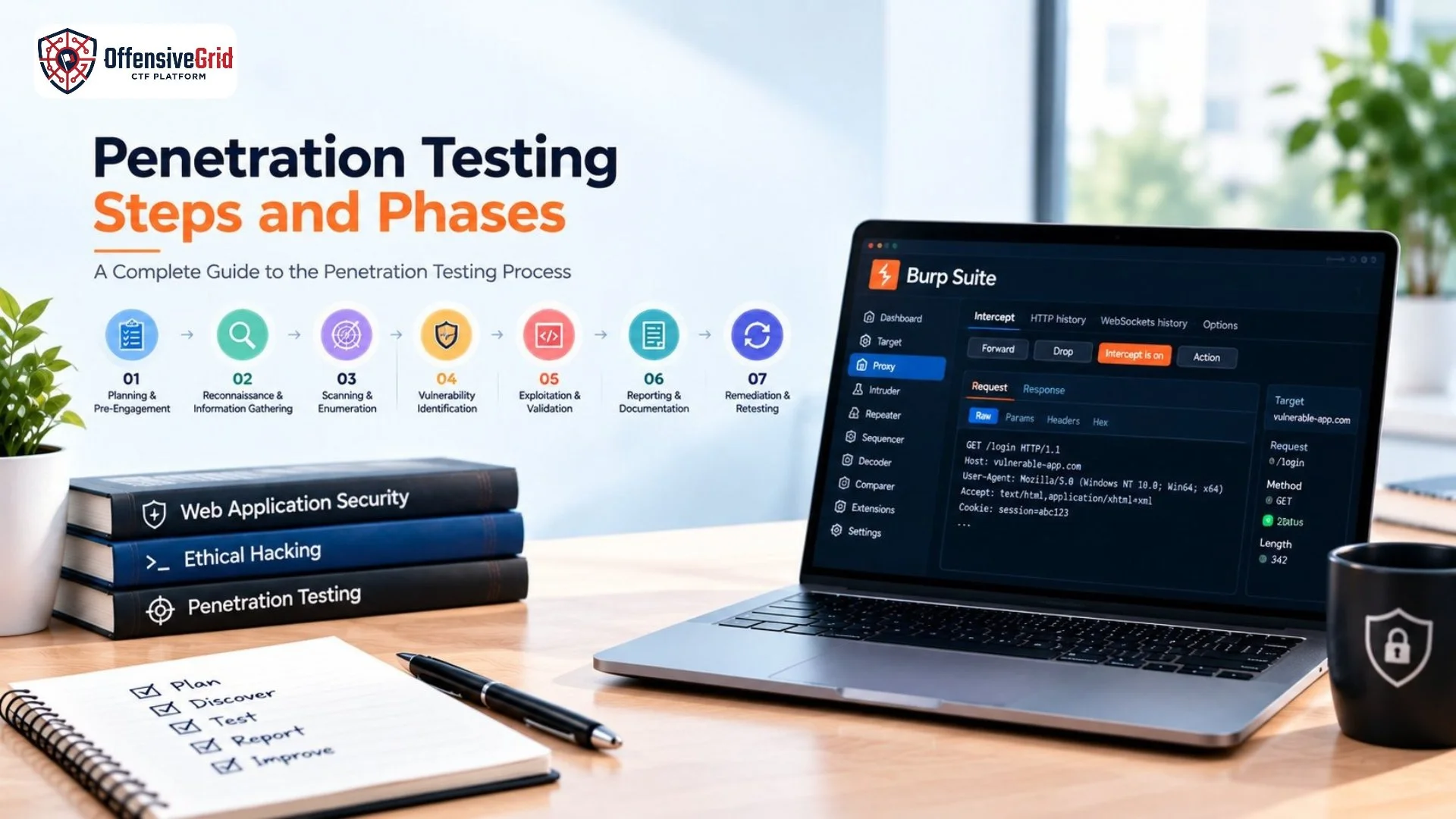
1. Planning and Pre-Engagement
The first phase of penetration testing is planning. Before any technical testing begins, the tester and organization establish the scope and rules of the engagement.
Defining the Scope
The scope identifies which systems and applications can be tested. It may include specific domains, IP addresses, applications, APIs, or network segments. The scope should also identify systems that must not be tested.
Establishing Rules of Engagement
Rules of engagement define how testing should be performed. They can include:
- Testing dates and times
- Approved testing techniques
- Target systems
- Prohibited activities
- Emergency contacts
- Testing limitations
- Data handling requirements
This phase is essential because penetration testing should always be performed with proper authorization.
2. Reconnaissance and Information Gathering
Reconnaissance involves collecting information about the target environment. The goal is to understand the attack surface before actively testing vulnerabilities.
Passive Reconnaissance
Passive reconnaissance gathers information without directly interacting with the target in a potentially intrusive way. Examples include reviewing publicly available information, DNS records, documentation, and other permitted sources.
Active Reconnaissance
Active reconnaissance involves interacting with the authorized target to identify information such as open ports, services, technologies, and accessible endpoints. The information gathered during reconnaissance helps testers determine where further testing should focus.
3. Scanning and Enumeration
After reconnaissance, testers perform scanning and enumeration to identify technical details about the target.
Common activities include:
- Port scanning
- Service identification
- Technology detection
- Directory discovery
- Subdomain enumeration
- API endpoint identification
- Network service enumeration
For web applications, testers may also examine HTTP requests, responses, cookies, headers, authentication mechanisms, and application functionality. The goal is not simply to collect a large amount of information but to identify areas that could require deeper security testing.
4. Vulnerability Identification
The next stage focuses on identifying potential vulnerabilities. Security testers may use automated vulnerability scanners alongside manual testing. Automated tools can quickly identify common weaknesses, while manual analysis helps validate findings and discover logic-related issues that automated tools may miss.
Potential findings can include:
- Injection vulnerabilities
- Broken access control
- Authentication weaknesses
- Security misconfigurations
- Insecure configurations
- Exposed sensitive information
- Weak session management
- Vulnerable software components
At this stage, findings should be carefully reviewed because automated scanners can produce false positives.
5. Exploitation and Validation
Exploitation is one of the most important penetration testing steps. In an authorized environment, testers attempt to safely validate whether identified vulnerabilities are actually exploitable. The purpose is not to cause unnecessary damage. Instead, testers demonstrate the security impact of a vulnerability while staying within the agreed rules of engagement.
For example, a tester may validate whether a vulnerability could allow unauthorized access, exposure of sensitive information, or privilege escalation.
Controlled Exploitation
Testing should remain controlled throughout the assessment. Testers should avoid destructive actions unless they are explicitly approved and necessary for the engagement. Evidence should be collected to demonstrate the vulnerability and its impact.
6. Post-Exploitation and Impact Analysis
When appropriate and authorized, testers may perform limited post-exploitation activities to understand what could happen after an initial compromise.
This phase can help answer questions such as:
- Could an attacker access sensitive resources?
- Could privileges be increased?
- Could another system be reached?
- What information could potentially be exposed?
- How far could the compromise extend?
The goal is to determine the potential business and technical impact rather than simply proving that one vulnerability exists.
7. Reporting and Documentation
Reporting is a critical part of the penetration testing process. A technically successful test is much less useful if the findings are not clearly communicated.
A penetration testing report commonly includes:
- Executive summary
- Scope and methodology
- Vulnerability descriptions
- Severity ratings
- Evidence
- Affected assets
- Potential impact
- Remediation recommendations
- Testing limitations
Each finding should provide enough information for the responsible team to understand the problem and take corrective action.
8. Remediation and Retesting
The final stage involves addressing identified vulnerabilities and verifying the fixes. After remediation, testers may perform a retest to determine whether the reported vulnerabilities have been properly resolved.
Why Retesting Matters
A vulnerability may appear fixed but remain exploitable because of incomplete remediation or related weaknesses. Retesting provides additional confidence that the security issue has been addressed.
This creates a useful cycle:
Test → Identify → Report → Remediate → Retest
Organizations can repeat this process regularly as their applications, infrastructure, and threat landscape change.
Common Penetration Testing Methodologies
Different organizations may use different methodologies depending on their requirements. Common approaches include:
Black Box Testing
The tester begins with limited knowledge of the target. This approach can simulate an external attacker with little initial information.
White Box Testing
The tester receives extensive information about the environment, such as source code, architecture, credentials, or documentation.
Gray Box Testing
The tester receives partial information about the target. This approach can simulate an attacker who already has some knowledge or access. The selected approach depends on the objectives, scope, and requirements of the security assessment.
Tools Used During Penetration Testing
Penetration testers use different tools throughout the assessment. The appropriate tools depend on the target and testing methodology.
Common categories include:
- Network scanning tools
- Web application testing tools
- Vulnerability scanners
- Password auditing tools
- Traffic analysis tools
- Enumeration tools
- Exploitation frameworks
- Reporting and documentation tools
For web security testing, Burp Suite is widely used for intercepting and analyzing HTTP traffic, testing requests, and manually validating application behavior. Learning through beginner cybersecurity CTF challenges can also help develop practical skills in reconnaissance, vulnerability analysis, exploitation, and problem-solving within controlled environments.
Practice Penetration Testing Safely
Penetration testing should only be performed against systems where you have explicit authorization. For practical learning, security professionals and students can use intentionally vulnerable applications, CTF platforms, virtual machines, private development environments, and authorized cybersecurity training labs. Platforms such as Offensive Grid can provide hands-on environments where learners can practice penetration testing techniques through controlled labs and security challenges. This lets users build practical skills without targeting real-world systems without permission.
Common Mistakes in Penetration Testing
Several mistakes can reduce the effectiveness of a penetration test.
Testing Without Authorization
Never test systems without explicit permission. Even security research can create legal, operational, or privacy issues when performed against unauthorized targets.
Relying Only on Automated Scanners
Automated scanners are useful, but they cannot replace human analysis. Manual testing is important for understanding business logic and validating potential vulnerabilities.
Ignoring the Scope
Testers should continuously follow the agreed scope. Accidentally testing an out-of-scope system can cause unexpected disruption.
Poor Documentation
Evidence, affected assets, testing methods, and remediation recommendations should be documented clearly throughout the engagement.
FAQs About Penetration Testing Steps and Phases
What are the main penetration testing phases?
The main phases generally include planning, reconnaissance, scanning and enumeration, vulnerability identification, exploitation, post-exploitation or impact analysis, reporting, and remediation or retesting.
How long does a penetration test take?
The duration depends on the scope, number of systems, application complexity, testing methodology, and assessment objectives. A small application assessment may take significantly less time than a large enterprise penetration test.
Is penetration testing the same as vulnerability scanning?
No. Vulnerability scanning primarily identifies potential security weaknesses using automated tools. Penetration testing goes further by manually validating vulnerabilities and assessing their potential impact within an authorized scope.
Can beginners learn penetration testing?
Yes. Beginners can start with networking, Linux, web technologies, security fundamentals, and controlled hands-on labs before progressing to more advanced penetration testing techniques.
Conclusion
Understanding the penetration testing steps and phases provides a structured approach to assessing cybersecurity weaknesses. From planning and reconnaissance to exploitation, reporting, remediation, and retesting, each phase contributes to a complete security assessment. Organizations can use penetration testing to identify weaknesses before they become serious security incidents, while security learners can develop practical skills through authorized labs and training environments. The key is to combine technical knowledge, careful methodology, proper documentation, and responsible testing practices.