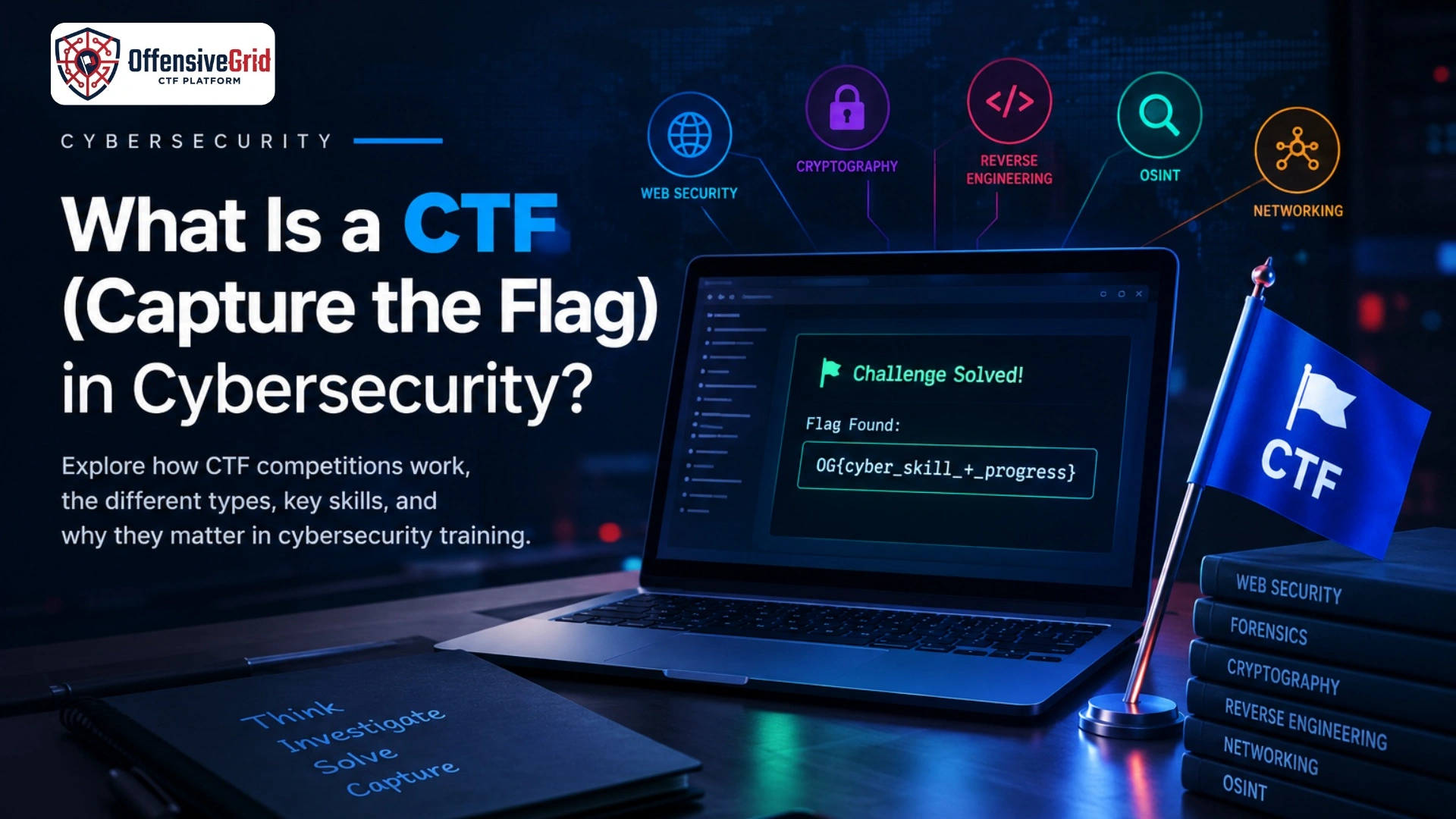
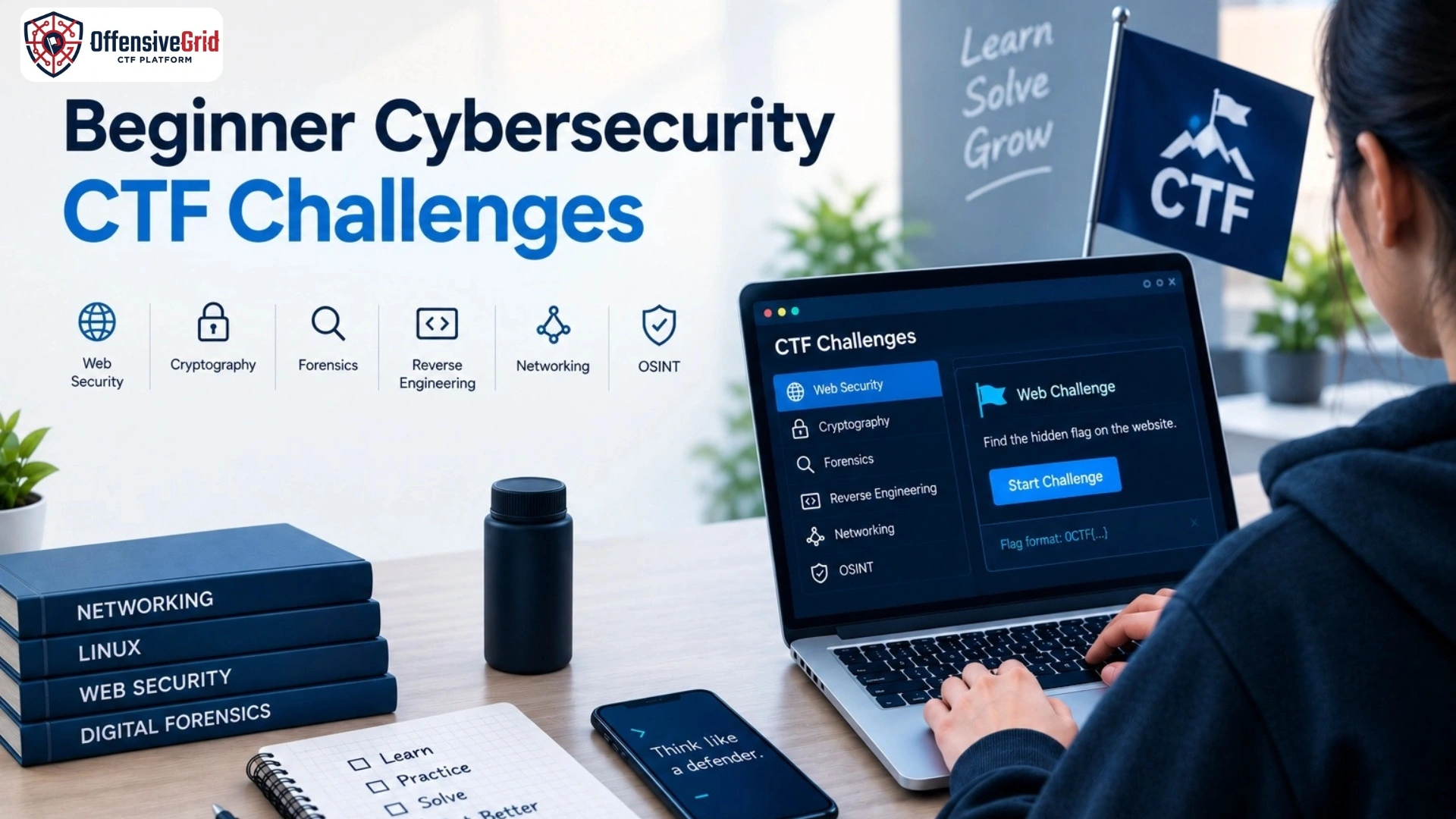
Cybersecurity can seem complex when you’re just starting. Beginner CTF (Capture the Flag) challenges provide a practical way to learn concepts like penetration testing, forensics, cryptography, reverse engineering, and network security.
CTF stands for Capture the Flag. In CTFs, participants solve security challenges in controlled environments to discover hidden flags. They help beginners build technical knowledge, problem-solving skills, and confidence through hands-on practice.
What Are Beginner Cybersecurity CTF Challenges?
Beginner cybersecurity CTF challenges are Capture the Flag exercises designed for people who have limited or no previous experience with cybersecurity competitions. Instead of requiring advanced exploitation techniques, beginner CTFs introduce fundamental concepts through simple and progressively difficult tasks.
A challenge might ask participants to:
- Decode a hidden message
- Find information inside a file
- Analyze basic network traffic
- Identify a weakness in a simple application
- Examine file metadata
- Investigate a simulated security incident
- Discover hidden information on a website
After solving the challenge, participants usually find a flag and submit it to the CTF platform to receive points. The purpose is not simply to win. For beginners, the real value of CTFs is learning how to approach cybersecurity problems logically and practically.
Why Should Beginners Try CTF Challenges?
Cybersecurity is a hands-on field. Reading about vulnerabilities and watching tutorials can build foundational knowledge, but practical exercises help turn that knowledge into usable skills.
Learn by Doing
CTFs allow beginners to interact with security challenges rather than only reading about them. Participants can investigate files, analyze traffic, examine applications, and test different approaches in a controlled environment.
Develop Problem-Solving Skills
CTF challenges encourage participants to research unfamiliar concepts, test ideas, and find solutions independently. This develops the analytical mindset required in cybersecurity.
Build Technical Confidence
Completing beginner challenges provides measurable progress. As learners solve more challenges, they become more comfortable with cybersecurity tools, terminology, and techniques.
Explore Cybersecurity Careers
CTFs expose beginners to different areas of cybersecurity. A learner may discover an interest in digital forensics, penetration testing, web security, networking, or threat analysis.
Best Beginner Cybersecurity CTF Challenge Categories
Beginners should start with fundamental categories before moving to advanced exploitation or complex reverse engineering.
Cryptography Challenges
Beginner cryptography challenges can introduce concepts such as encoding, decoding, substitution ciphers, and basic encryption. For example, participants may receive an encoded message and need to determine how it was transformed before recovering the flag.
Digital Forensics Challenges
Forensics challenges involve examining digital evidence to find useful information. Beginner tasks may include:
- Checking file metadata
- Searching logs
- Examining suspicious files
- Inspecting network captures
- Finding hidden information
These exercises introduce the investigative mindset used in real cybersecurity incidents.
Web Security Challenges
Beginner web CTF challenges help participants understand how websites and web applications work. Challenges may involve examining HTTP requests, cookies, parameters, authentication, or hidden pages. They provide an introduction to common web security concepts in a controlled environment.
OSINT Challenges
OSINT stands for Open-Source Intelligence. These challenges teach participants how to collect and connect information from publicly available sources. A challenge might provide a username, image, website, or other clue and require participants to discover additional information.
Networking Challenges
Networking CTF challenges introduce participants to network communication and protocols. Beginners can practice understanding:
- IP addresses
- Ports
- TCP and UDP
- DNS
- HTTP
- Network packets
These fundamentals are useful for both offensive and defensive cybersecurity roles.
Linux and Command-Line Challenges
Cybersecurity professionals frequently work with command-line tools. Beginner CTFs can introduce basic Linux commands for navigating directories, searching files, reading information, and investigating systems. Learning these fundamentals can make future cybersecurity labs much easier to understand.
Examples of Beginner CTF Challenges
Beginners do not need to start with complicated hacking techniques. Simple challenges can teach important cybersecurity concepts.
Find a Hidden Flag
Participants receive a text file containing information and need to search for a specific hidden flag.
Decode a Message
A challenge provides an encoded message. Participants identify the encoding method and decode it to reveal the flag.
Investigate File Metadata
Participants receive an image or document and examine its metadata to find information related to the challenge.
Analyze Network Traffic
A packet capture is provided, and participants inspect the traffic to identify a suspicious request containing the flag.
Find a Hidden Web Resource
Participants receive a simple website and investigate its structure to locate a hidden page or resource. These exercises help beginners develop investigation and analytical skills without requiring advanced knowledge.
What Skills Do You Need Before Starting a CTF?
You do not need to be an expert hacker to participate in a CTF. However, a few fundamentals can make the learning process easier.
Basic Networking
Understand concepts such as IP addresses, ports, DNS, HTTP, and common protocols.
Linux Fundamentals
Learn how to navigate directories, create and read files, search for information, and use basic terminal commands.
Basic Programming
Advanced programming is not required, but basic Python or scripting knowledge can help automate repetitive tasks.
Web Fundamentals
Understanding browsers, HTTP requests, cookies, forms, and basic web architecture is useful for web security challenges.
Logical Thinking
Perhaps the most important skill is curiosity and logical thinking. If you do not immediately know how to solve a challenge, investigate the problem step by step and research the underlying concept.
How to Start Solving Beginner CTF Challenges
A structured approach can make your first CTF experience much easier.
Start With the Fundamentals
Learn basic networking, Linux, web technologies, and cybersecurity concepts before attempting difficult challenges.
Choose Easy Challenges
Look for challenges specifically labeled beginner, introductory, or easy. Avoid starting with advanced binary exploitation or complex reverse engineering.
Read the Challenge Carefully
Challenge descriptions often contain useful clues. Pay attention to filenames, unusual words, numbers, extensions, and other details.
Research When You Get Stuck
Getting stuck is a normal part of CTF learning. Research the underlying concept and try different approaches instead of immediately searching for the complete solution.
Keep Learning Notes
Record useful commands, tools, techniques, and concepts. These notes can become a valuable personal cybersecurity reference.
How CTFs Build Real Cybersecurity Skills
CTFs encourage participants to think like cybersecurity professionals. With regular practice, learners can develop:
- Analytical thinking
- Problem-solving skills
- Research abilities
- Technical troubleshooting
- Security tool familiarity
- Team collaboration
- Incident investigation skills
- Offensive and defensive security knowledge
Organizations can also use CTFs for cybersecurity workforce development, skills assessment, and practical training.
How Offensive Grid Supports Hands-On Cybersecurity Learning
Practical cybersecurity skills develop best in realistic, controlled environments. Offensive Grid provides hands-on cybersecurity training and CTF-based learning environments designed to help participants develop practical security capabilities. CTF exercises can help universities, enterprises, and security teams engage learners, assess technical skills, and provide practical experience across multiple cybersecurity domains. Organizations can also use structured cyber exercises to identify skill gaps and support ongoing cybersecurity workforce development.
Frequently Asked Questions About Beginner CTF Challenges
Are CTF challenges suitable for complete beginners?
Yes. Beginner-focused CTF challenges are specifically designed to introduce cybersecurity concepts through practical and manageable exercises.
Do I need programming skills to participate in a CTF?
No. Some challenges require programming, but beginners can start with areas such as forensics, OSINT, basic cryptography, and simple web challenges.
What should I learn before starting CTFs?
Basic networking, Linux commands, web fundamentals, cybersecurity concepts, and some scripting knowledge provide a useful foundation.
Are cybersecurity CTF challenges legal?
CTFs are legal when participants work within authorized environments provided for the competition or training exercise. Real systems should never be tested without permission.
Can CTFs help with a cybersecurity career?
Yes. CTFs can help develop practical skills relevant to penetration testing, SOC operations, digital forensics, threat hunting, security research, and other cybersecurity roles.
Conclusion
Beginner cybersecurity CTF challenges provide an effective way to move from cybersecurity theory to practical learning. By solving challenges involving cryptography, web security, digital forensics, networking, OSINT, and Linux, beginners can gradually build technical skills and confidence. The best approach is to start with simple challenges, learn from mistakes, research unfamiliar concepts, and practice consistently. You do not need to know everything before starting a CTF; the challenges themselves are an opportunity to learn. Whether you are a cybersecurity student, aspiring professional, educator, or organization developing security talent, CTFs can make cybersecurity learning more practical, engaging, and measurable.