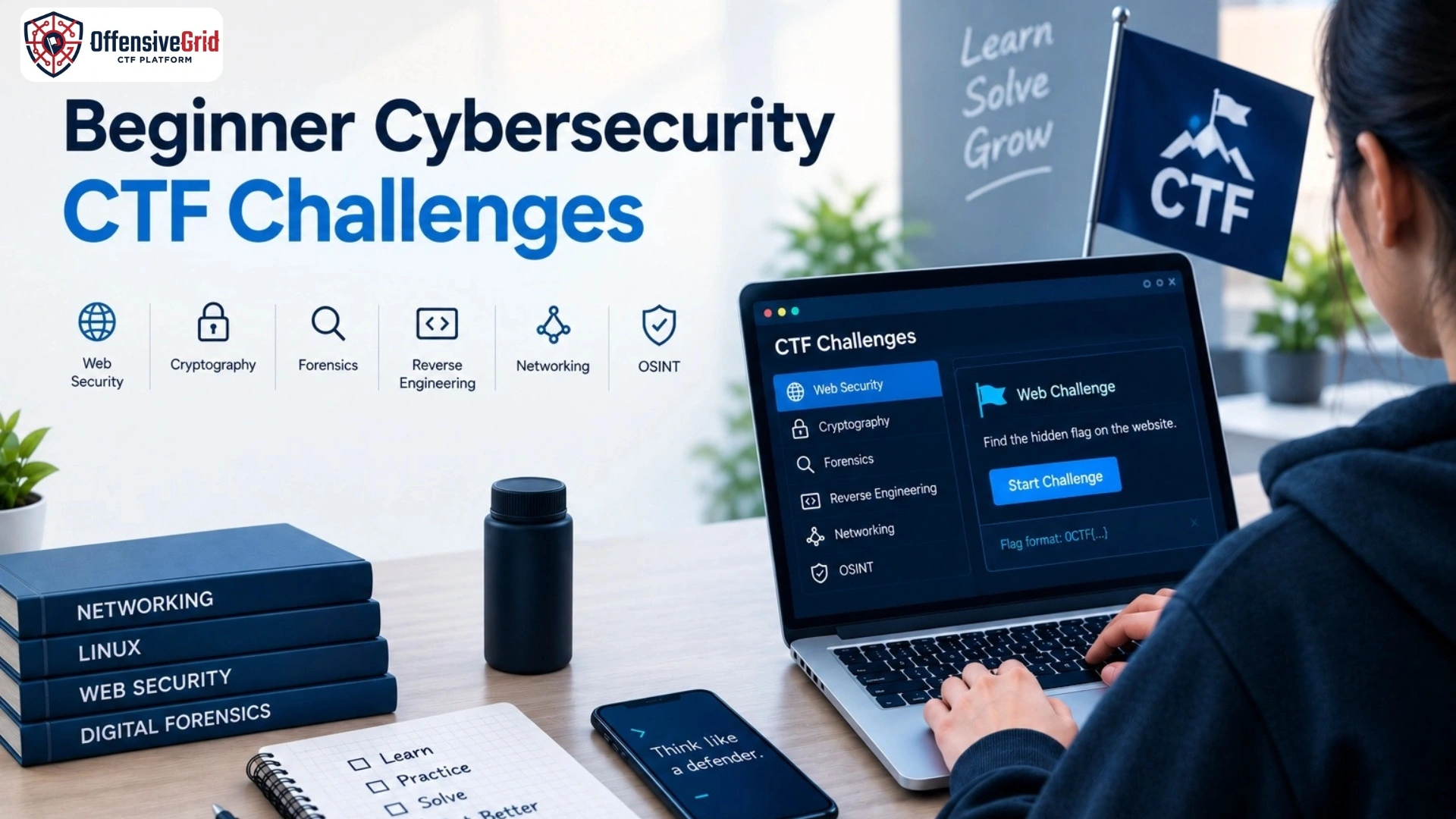
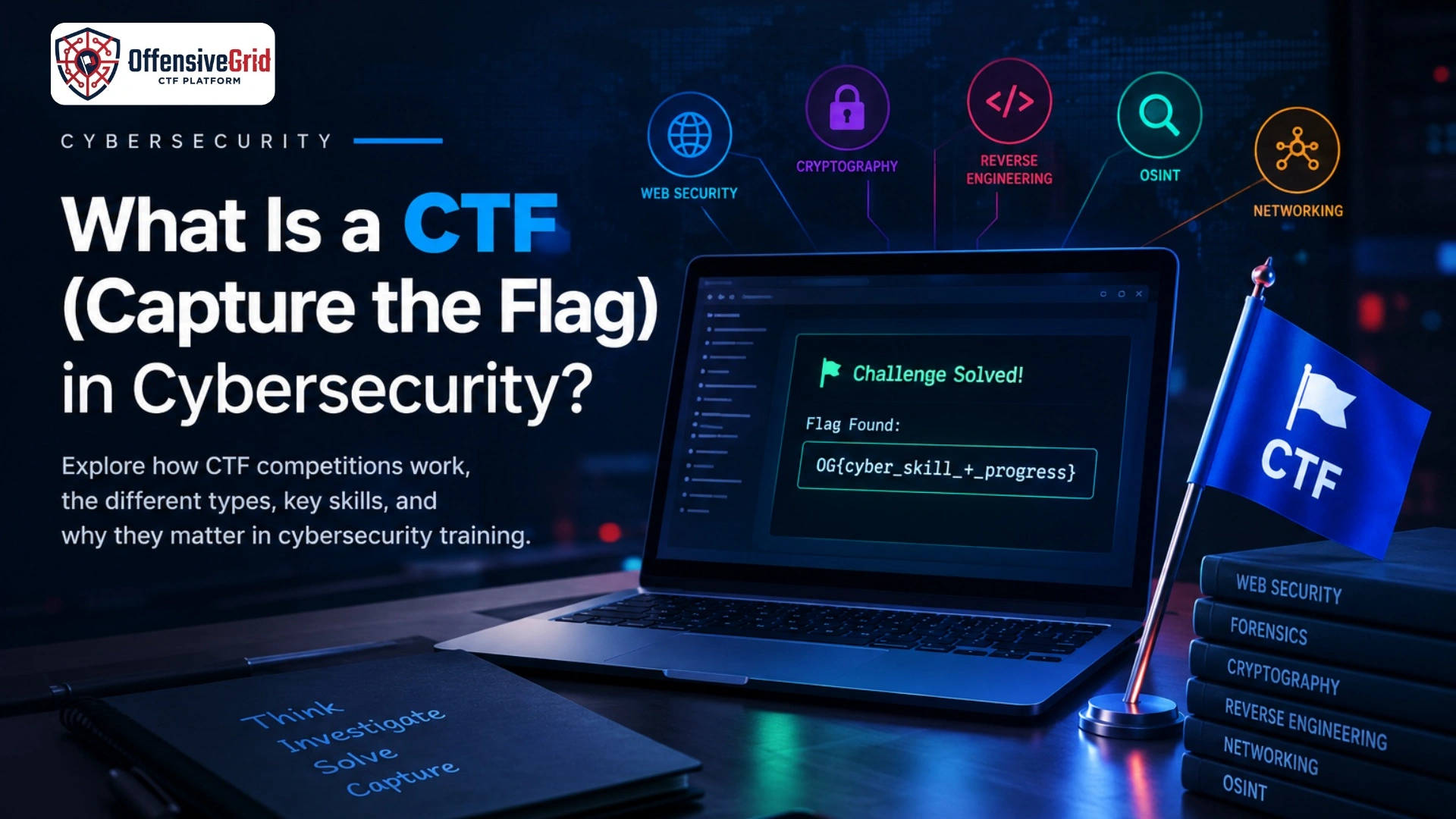
Cybersecurity requires practical skills, not just theoretical knowledge. Professionals need hands-on experience identifying vulnerabilities, analyzing attacks, investigating digital evidence, and defending systems. CTF (Capture the Flag) cybersecurity competitions provide a safe way to develop these skills through realistic security challenges.
What Is a CTF in Cybersecurity?
CTF stands for Capture the Flag. In cybersecurity, it refers to a challenge-based environment where participants complete security-related tasks and discover hidden flags. A flag is usually a specific string of text that proves a participant has successfully solved a challenge. Once found, participants submit the flag to the CTF platform and receive points. For example, a challenge might provide a vulnerable web application. Participants could investigate the application, identify a security weakness, and use it to locate the hidden flag.
The objective of a cybersecurity CTF is not simply to hack a system. Instead, CTFs are designed to develop problem-solving, security analysis, offensive security, and defensive security skills within an authorized environment.
How Does a Cybersecurity CTF Work?
Although different CTF competitions use different formats, the basic process is usually similar.
Participants Receive Challenges
Participants are given a collection of cybersecurity challenges. Each challenge may focus on a different security concept or technical skill.
Common challenge categories include:
- Web application security
- Cryptography
- Digital forensics
- Reverse engineering
- Networking
- OSINT
- Steganography
- Binary exploitation
Participants Analyze the Problem
Participants investigate the challenge and determine how to solve it. Depending on the challenge, this may involve analyzing files, network traffic, source code, applications, or system behavior.
Participants Find the Flag
After solving the challenge, participants discover the hidden flag.
The Flag Is Submitted
The discovered flag is submitted through the competition platform. If it is correct, the participant receives points.
Teams Compete on a Leaderboard
Many CTF platforms use leaderboards to rank individuals or teams based on their scores. This competitive element encourages participants to solve more challenges while developing their cybersecurity skills under time pressure.
What Are the Different Types of CTFs?
There are several types of Capture the Flag competitions, and each provides a different learning experience.
Jeopardy-Style CTF
Jeopardy-style CTFs consist of independent challenges divided into categories such as web security, forensics, cryptography, and reverse engineering. Participants can choose challenges based on their interests and technical abilities. This format is particularly popular for cybersecurity education and competitions.
Attack-and-Defense CTF
In an attack-and-defense CTF, teams are responsible for both attacking other systems and protecting their own. Participants may need to identify vulnerabilities, exploit weaknesses, patch systems, monitor activity, and detect attacks. This format helps develop both red team and blue team skills.
King of the Hill CTF
King of the Hill competitions focus on gaining and maintaining control over a target system or environment. Participants must maintain their position while attempting to take control from competitors. These exercises can help develop skills related to system security, persistence, monitoring, and defense.
Scenario-Based CTF
Scenario-based CTFs provide more realistic cybersecurity situations instead of isolated puzzles. For example, participants might investigate a simulated security incident, analyze compromised systems, identify an attack path, or respond to suspicious activity. These exercises can provide a more realistic introduction to professional cybersecurity operations.
What Skills Can You Learn From CTFs?
One of the biggest advantages of CTF cybersecurity training is the range of technical skills participants can develop.
Web Security
Web-based challenges can introduce participants to application vulnerabilities, authentication issues, access control problems, insecure input handling, and other web security concepts.
Digital Forensics
Forensics challenges require participants to analyze digital evidence such as logs, files, memory captures, or network traffic.
These exercises can improve skills needed for incident response and security investigations.
Cryptography
Cryptography challenges help participants understand encryption, encoding, hashing, keys, and weaknesses in cryptographic implementations.
Reverse Engineering
Reverse-engineering challenges involve analyzing software or compiled programs to understand how they work.
These skills can be useful in areas such as malware analysis and vulnerability research.
Network Security
Network-based challenges help participants understand protocols, network traffic, services, and suspicious communications.
OSINT
OSINT challenges teach participants how to collect and analyze publicly available information to solve security-related problems.
Programming and Scripting
Many CTF challenges require automation or custom scripts. Participants can therefore improve their programming and scripting abilities while solving security problems.
Why Are CTFs Important for Cybersecurity Training?
CTFs are valuable because they transform cybersecurity learning from passive theory into active problem-solving.
Hands-On Experience
Instead of simply reading about vulnerabilities, participants interact with controlled environments and attempt to solve actual security challenges.
Problem-Solving Skills
Cybersecurity professionals regularly encounter unfamiliar problems. CTFs encourage participants to investigate, research, test ideas, and develop solutions independently.
Practical Skill Assessment
CTF results can help educators and organizations evaluate technical capabilities. Challenge performance can highlight strengths as well as areas where additional training may be beneficial.
Team Collaboration
Team-based CTF competitions require participants to communicate, divide tasks, share discoveries, and combine different technical skills.
Realistic Challenges
Advanced CTF environments can simulate aspects of real-world networks, applications, attacks, and security incidents, giving participants practical experience in a controlled setting.
CTFs for Cybersecurity Students and Universities
CTFs can be an effective addition to university cybersecurity programs. Students can use CTF competitions to apply concepts learned in courses such as networking, programming, ethical hacking, digital forensics, and information security.
Participating in CTFs can help students:
- Develop practical cybersecurity skills
- Build confidence with security tools
- Discover different cybersecurity career paths
- Improve problem-solving abilities
- Gain teamwork experience
- Build practical projects for their portfolios
Universities can also organize customized CTF events to engage students and provide measurable hands-on learning experiences.
CTFs for Enterprises and Cybersecurity Teams
CTFs are not only useful for students. Organizations can use customized CTF environments for cybersecurity workforce development and skills assessment.
For example, an enterprise could create challenges focused on:
- Threat detection
- Incident response
- Penetration testing
- Digital forensics
- Network security
- Threat hunting
- Active Directory security
- Web application security
Organizations can use participant performance to identify technical skill gaps and determine where additional training is required. A structured CTF program can therefore become part of a broader cybersecurity readiness strategy.
How CTFs Support Red, Blue, and Purple Teams
CTFs can also support different cybersecurity team functions.
Red team challenges can help participants practice offensive security concepts such as reconnaissance, vulnerability discovery, and exploitation within authorized environments.
Blue team challenges can focus on detection, log analysis, threat hunting, and incident response.
Purple team exercises combine offensive and defensive perspectives. One side simulates adversarial activity while the other evaluates whether security controls can detect and respond to it.
This makes CTFs useful for developing technical capabilities across multiple areas of cybersecurity.
Are CTFs Safe and Legal?
Legitimate CTF competitions provide participants with systems and environments that are specifically designed for authorized security testing. Participants should only test systems they own, systems provided by the competition, or systems for which they have explicit permission. Attempting to exploit real websites, networks, or applications without authorization is not legitimate CTF participation and can have serious legal and security consequences.
The purpose of a CTF is to provide a safe, controlled environment for cybersecurity practice.
Frequently Asked Questions About CTFs
What does CTF stand for in cybersecurity?
CTF stands for Capture the Flag. It is a cybersecurity competition or practical exercise where participants solve security challenges to discover hidden flags.
Is CTF good for beginners?
Yes. Beginner-friendly CTFs can help new learners develop practical cybersecurity skills through guided and progressively difficult challenges.
What skills are needed for a CTF?
Basic knowledge of networking, Linux, programming, web technologies, and cybersecurity concepts can be helpful. The required skills depend on the difficulty of the competition.
Are CTFs only for hackers?
No. CTFs can involve many cybersecurity disciplines, including digital forensics, OSINT, cryptography, network analysis, web security, threat detection, and reverse engineering.
Can companies use CTFs for employee training?
Yes. Companies can use customized CTFs to assess technical skills, identify knowledge gaps, improve teamwork, and provide hands-on cybersecurity workforce training.
Conclusion
A CTF (Capture the Flag) in cybersecurity is a practical and engaging way to develop cybersecurity skills. By solving challenges and finding hidden flags, participants gain hands-on experience in areas such as web security, digital forensics, cryptography, networking, OSINT, reverse engineering, and penetration testing. For students, CTFs provide an opportunity to turn classroom knowledge into practical skills. For enterprises and cybersecurity teams, customized CTFs can support workforce development, skills assessment, and cyber readiness. The most effective CTF programs combine realistic challenges, controlled environments, measurable performance, and progressive learning. Whether you are a beginner learning cybersecurity or an organization developing a professional security team, CTFs can provide a valuable hands-on learning experience.